
Great Kolinsky Brush: How to Choose, Use, & Maintain It (and Top Picks from Dynamic Nail Supply)
The Power of a Great Kolinsky Brush: How to Choose, Use, & Maintain It (and Top Picks from Dynamic Nail Supply)
In the world of acrylic nail art, the difference between a good result and a wow result often comes down to your brush. A top-tier Kolinsky hair brush gives precision, control, and longevity. Many nail techs swear by it. In this post, we’ll explore what makes a great Kolinsky brush, how to choose one wisely, how to care for it, and some top picks (including from Dynamic Nail Supply) you can trust.
1. What Is a Kolinsky Brush — And Why It’s So Coveted
A Kolinsky brush isn’t a brand — it refers to a specific type of natural hair (from the tail of the Mustela sibirica). These hairs are prized for their ability to hold liquid, spring back to shape, and taper to a fine tip — qualities that are ideal for sculpting acrylic nails. Wikipedia
Because the sourcing and manufacturing are more complex, high-quality Kolinsky brushes tend to cost more — but when done well, they outperform many synthetics or lower-quality natural brushes in control, durability, and finesse.
2. Key Features to Evaluate
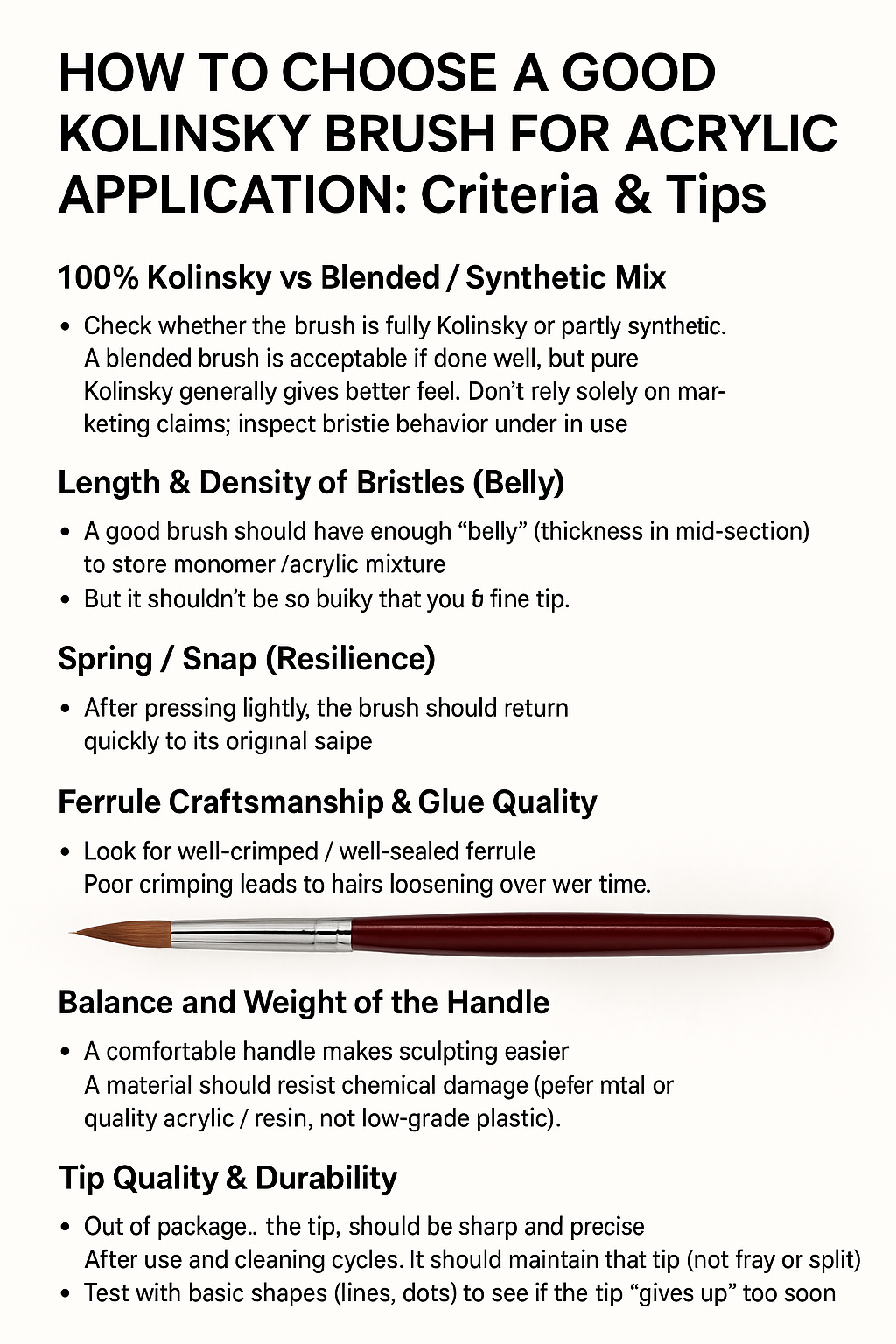
When shopping or recommending Kolinsky brushes, use the following checklist:
-
Pure Kolinsky or blend? Full Kolinsky is best; blends are okay if the synthetic portion is high quality.
-
Full belly / density to hold monomer + powder.
-
Snap / spring: It must spring back quickly, not splay under pressure.
-
Bristle taper & tip: Uniform taper to an acute point is ideal.
-
Ferrule & glue quality: Well-crimped, sealed, durable structure.
-
Balance & handle weight: Comfortable grip for longer use.
-
Chemical / soak tolerance: Bristles, glue, ferrule, handle must resist corrosion / degradation.
-
Brand transparency & support: Good documentation, replacement policies.
-
User reviews & longevity tests: Look for months/years of reliable use.
-
Proper size / shape for your technique (e.g. size 10, crimped, flat, round).
3. Common Issues & How to Spot / Avoid Them
-
Flared / split bristles soon after use
-
Acrylic “sticking / gumming up” inside the brush (not releasing as a clean bead) — often due to low-quality glue or bristles
-
Ferrule loosening or hair shedding
-
Loss of snap / limp brush over time
-
Poor resistance to cleansers / acetone
If possible, before committing, test the brush: do a few sculpting beads, clean it multiple times, soak it (within specified limits) — and see how the tip holds up.
In forums, new techs sometimes express frustration:
“Every time … the acrylic sticks to my brush like glue … ruined brushes … got a 100% Kolinsky but still … worried I got scammed.”
So choosing carefully is critical.
4. Making the Most of Your Brush — Care & Best Practices
-
Never soak in acetone / cleaner too long — Dynamic’s guideline is max 15 minutes. Dynamic Nail Supply
-
Use proper brush cleaner (not harsh solvents)
-
Flush out product after each use — don’t let acrylic cure inside the brush
-
Reshape the tip after cleaning (spin or draw on paper)
-
Store upright or with protective cap
-
Avoid pulling / bending the bristles
-
Rotate brushes (don’t overuse a single one continuously)
-
Periodically inspect ferrule and bristle integrity
With good care, a premium Kolinsky brush can last many months (or even longer) with minimal degradation.
-
Posted in
Acrylic Application Brush, Acrylic Brush, Choosing the Best Acrylic Powder, Kolinsky Brush, Kolinsky Hair Brush, Nail Brush
)